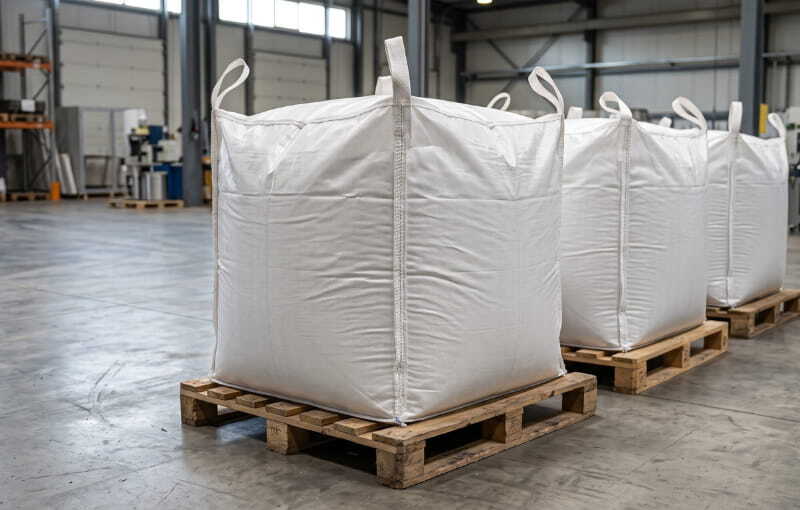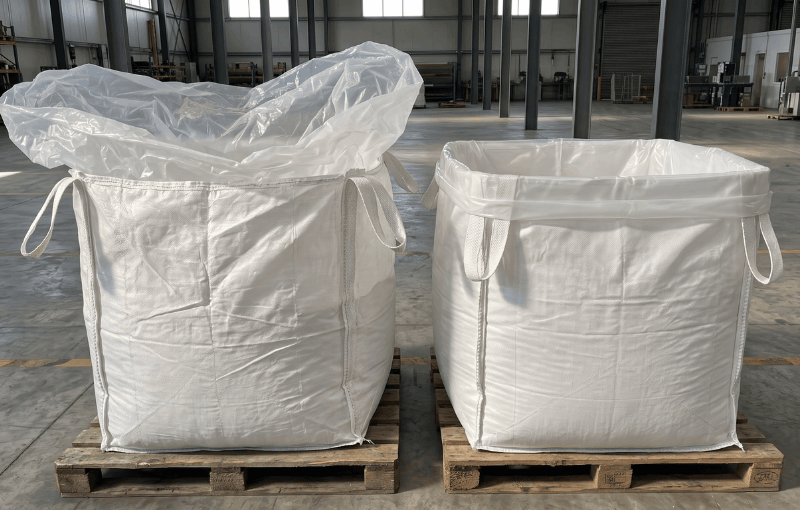
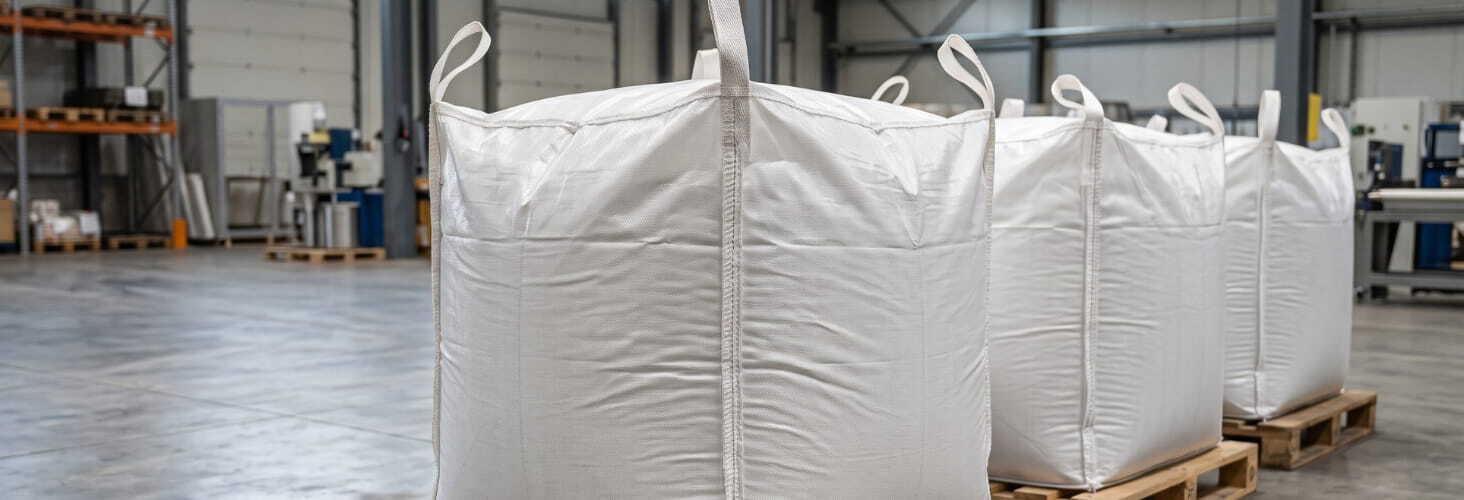
A standard bulk bag filled with plastic pellets slumps outward into something close to a barrel. A baffle bag filled with the same pellets stands up square. That is the idea behind baffle bags FIBC buyers see listed as “Q-bags”: internal corner panels that stop the bulge, so the bag sits within its pallet. This guide explains how the construction works, which body to build it on, and when the extra cost comes back
Key Takeaways
- Baffles are fabric panels sewn across the inside of an FIBC’s four corners. They hold the filled bag square instead of letting it round out.
- Baffle bags are a widely specified FIBC option. They are chosen mainly for palletised storage and containerised shipping, where a square profile matters.
- Baffles modify a body; they are not a body type. They are most often sewn into a four-panel body.
- The space benefit depends on the product. It pays on light products that fill a container by volume, and fades on dense products that hit the weight limit first.
- A baffle says nothing about food grade, moisture or dust performance. Specify those separately.
What Is a Baffle Bag and How Does It Work?
A baffle bag is an FIBC incorporating internal fabric panels stitched across its corners to help maintain its shape when filled. These panels connect adjacent side walls and help reduce outward bulging, allowing the bag to retain a more consistent shape during storage and transportation. When the bag is filled, the product pushes the walls outward. In a standard bag nothing resists that push, so the walls bow. In a baffle bag the corner panels go into tension and hold adjacent walls at a fixed distance, so the bag keeps a near-square footprint from base to top.
Baffle designs incorporate openings or other suitable product-flow arrangements to allow material to enter and discharge from the corner areas. The opening design should be selected according to the material’s flow characteristics and discharge requirements. Some designs use straps or cords instead of full panels. Opening size matters: too small, and a fine or slightly cohesive powder can bridge across, leaving corners part-empty or holding residue after discharge.
Terminology is not standardised: baffle bag, Q-bag, form-stable FIBC and shape-retaining bulk bag describe the same construction, and “Q-bags FIBC” is trade shorthand for a squared footprint. None is defined in EN ISO 21898, so specify the construction, not the label. See the fuller glossary of FIBC construction terms.
Baffles sit across the corners and carry openings so product still reaches the corner pockets.
Circular, U-Panel and Four-Panel: Which Body Should Carry the Baffles?
The three body constructions differ in their structural design and shape-retention characteristics. Four-panel construction generally provides a more defined shape, while U-panel and circular constructions offer different structural and manufacturing advantages. Adding baffles can improve shape retention by restricting outward bulging, depending on the underlying body construction and bag design. So the baffle bag construction types a buyer really chooses between are “which body, and is it baffled”. Seam counts and fabric use for each body are covered in our four-panel vs U-panel vs circular comparison. Here the question is what baffling each one does.
| Body | Unbaffled shape | With baffles | Notes |
|---|---|---|---|
| Four-panel | Most consistently square | Squarest result; the most common baffle build | Most pieces and stitching; corner seams anchor the baffles |
| U-panel | Between rounded and square | Squares up well; a frequent alternative | Fabric continuous across the base between two walls |
| Circular | Rounded, barrel-like | Improves, but the tube still rounds out between corners | Least common baffle build; no vertical body seams |
General industry description. The shape ranking is qualitative; no standard defines a shape-retention test.
The trade-off runs from manufacturing simplicity to shape retention. A baffled four-panel bag combines four side panels and a separate base panel with additional internal baffles. This construction involves additional fabric components and stitching compared with a standard FIBC. The final shape and performance depend on the bag’s dimensions, material and construction specifications. A baffled circular body keeps fewer seams but will not stand as square. For palletised, multi-tier storage, baffled four-panel or U-panel is the practical choice. See the full FIBC manufacturing process.
Baffle construction introduces additional stitching and internal seams that form part of the overall bag design. Buyers should ensure that the complete FIBC design, including its baffles, seams and lifting arrangements, has been evaluated against the applicable requirements. Always confirm the safe working load, safety factor and relevant test documentation for the specific bag configuration.
Does Baffle Construction Actually Save Storage and Transport Space?
Yes, baffle bags can help improve storage and transportation efficiency by maintaining a more consistent shape and reducing outward bulging. However, the actual space utilisation benefits depend on bag dimensions, product density, pallet configuration and container loading conditions. Baffle bags FIBC suppliers cite better pallet fit and cube use, and industry commentary credits them with higher stack density, without numbers. We have found no independently tested figure and will not invent one.
What can be stated is the geometric ceiling. A perfectly round bag in a square footprint fills about 78.5% of it (pi divided by four); a perfectly square bag fills all of it. At the same height, a fully square profile therefore holds up to roughly 27% more in the same floor space than a perfectly round one. This is a theoretical geometric comparison and does not represent a tested or guaranteed space-saving figure for commercially manufactured FIBC bags.
That is why the product matters more than the bag. Materials such as polymer pellets, granules and certain powders may benefit from improved space utilisation when their bulk density allows container capacity to be reached before the maximum payload. Dense materials such as sand, cement and certain mineral products may reach transport weight limits sooner. Actual suitability should be assessed based on the product’s measured bulk density and loading conditions. Typical densities are in our bulk density guide. Free-flowing powders, pellets, granules, resins and minerals fill baffle corners well; cohesive, bulky or irregular materials may not flow into the corners and need case-by-case trials.
In the warehouse, squarer bags stack more stably, but stacking is a tested property under EN ISO 21898, so confirm the result for the actual design.
When Is the Added Cost of Baffle Construction Worth It?
Baffle construction may involve additional material and stitching compared with a standard FIBC of similar capacity. The overall cost depends on the bag’s design, dimensions, fabric specifications and customisation requirements. Whether that pays back depends on whether your logistics use the shape retention. Judge it on cost per tonne delivered and stored, not cost per bag, as set out in our FIBC total cost of ownership guide.
Baffle bags usually earn their premium when:
- the product is light and free-flowing, so containers and trailers fill by volume;
- bags are racked or block-stacked two or more high;
- a rounded profile leaves dead space along container walls;
- automated handling or pallet scanning needs a consistent footprint.
They are harder to justify for dense products, bags that go straight into a silo intake, or single-layer storage with floor space to spare.
Baffle construction is primarily intended to improve the shape retention of an FIBC. Food-grade suitability, moisture protection and dust containment are separate requirements that depend on the materials, coating, liner and stitching specifications. Buyers should confirm the appropriate liner and construction options based on their product and application requirements.
This article is general guidance and does not replace your own EHS, compliance or handling risk assessment, including stacking and safe-working-load checks for your site.
How Do You Specify a Baffle Bag?
Put these lines in the RFQ so every supplier quotes the same bag:
- Product: compacted bulk density, flow behaviour, fill temperature.
- Body and baffle: four-panel, U-panel or circular; panel or strap baffles; opening size for fine powders.
- Footprint and height: matched to your pallet (for example 1,200 x 1,000 mm) and container or trailer height.
- SWL and safety factor: EN ISO 21898 class, with the relevant test documentation for the specific baffled configuration.
- Top, bottom, loops, liner and UV: spouts, lift style, form-fit liner if needed, UV for outdoor storage.
What Mewar Polytex publishes
Everything above is general industry information. The table below comes from Mewar Polytex’s own product pages and is kept separate.
| Specification | Mewar Polytex published figure |
|---|---|
| FIBC body types | U-body, four side panels plus base, circular, and four side panels plus base with baffles |
| FIBC safe working load | 1,000 to 3,000 lb (approximately 450 to 1,360 kg), tested at 5:1 or higher |
| Body fabric | 120 to 250 GSM |
| Q-bag standard sizes | 90 x 90 cm and 120 x 120 cm, plus custom sizes |
| Grades | Industrial and food grade |
Source: Mewar Polytex FIBC bulk bags and Q-bags product pages. Confirm the rating for a specific design on its specification sheet.
Mewar Polytex manufactures FIBC bulk bags through a vertically integrated production process, PP tape extrusion, weaving, lamination, printing and bag fabrication, with 46+ years of experience, 14 manufacturing facilities, 8,000+ tonnes of monthly capacity and exports to more than 25 countries. Mewar Polytex International B.V., the group’s European subsidiary, is an EFIBCA member. See our Q-bags and FIBC bulk bags.
Frequently Asked Questions
What is a baffle bag?
An FIBC with fabric panels or straps sewn across the inside of its four corners. They hold the walls together so the filled bag stays square instead of bulging like a standard bulk bag, while openings let product reach the corners.
What is the difference between circular, U-panel and 4-panel baffle bags?
The body the baffles are sewn into. Four-panel construction generally provides a more defined shape, while U-panel and circular constructions offer different structural and manufacturing advantages. Baffled four-panel is the most common build.
Do baffle bags save storage space?
They improve pallet fit and stack density, but no independently tested percentage is published. Geometry caps the gain at roughly 27% over a perfectly round bag in the same footprint; real gains are smaller and depend on density and loading.
Are baffle bags more expensive than standard FIBC bags?
They can be, as baffle construction may involve additional material and stitching; the overall cost depends on design, dimensions and fabric. The premium pays back when shipments are volume-limited or storage depends on stable, square stacks.
What products are baffle bags best suited for?
Light, free-flowing materials such as polymer pellets, resins, granules and many powders. Below roughly 850 kg/m³ a container usually fills by volume first. Cohesive or irregular materials may not fill the corners and need trials.
Does Mewar Polytex offer baffle bag construction?
Yes. Mewar Polytex publishes a four side panel plus base body with baffles in its FIBC range, and a Q-bag product in 90 x 90 cm and 120 x 120 cm standard sizes plus custom sizes. Ask the Amsterdam team which bodies suit your product.
Conclusion
Baffle bags stop the outward bulge of a standard FIBC by tying the corners together, and work best on a four-panel or U-panel body. The benefit is real but product-dependent: it pays on light, free-flowing products that fill containers by volume and fades on dense products that weight out first. With no tested savings figure published, judge baffle bags FIBC options against your own pallet, container and density numbers, and ask for the relevant test documentation for the specific baffled configuration. Tell us your product, density and preferred body, and request a quote from our Amsterdam team.